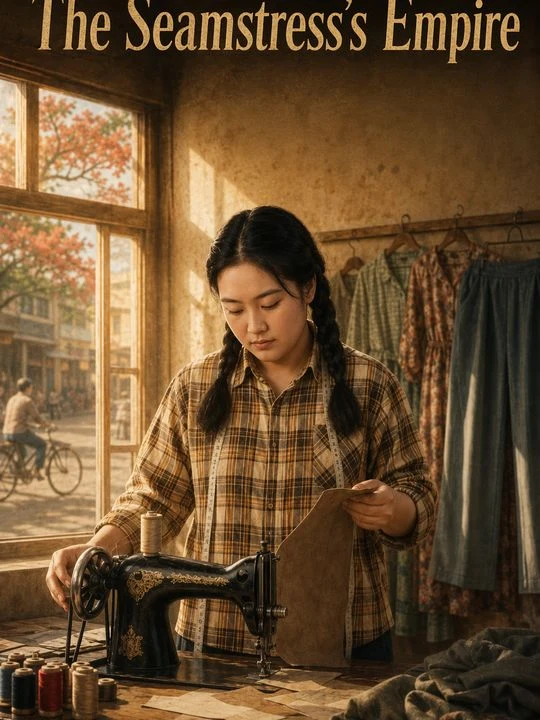
A fifth wedding anniversary is usually an occasion for deciding what a marriage has become. For Flora Shaw it is the day to leave. She and Linden became husband and wife because their fathers reached an agreement, and five years have given the two of them ample opportunity to see how little that agreement says about living together. Flora takes the skill she can carry with her and heads to Southport. The decision has a pleasing concreteness. She knows how to sew, and the city gives her a place to find out what that ability can support. It is a story about a business whose earliest investment is a woman taking seriously something she has spent years learning to do.
The customer a dressmaker has to imagine
Flora decides to make clothing for plus-size women. In a less observant rise-to-success story, the business could have made almost anything, because the important fact would be how much it is worth once she has succeeded. Here, the choice of customer tells us what the work demands. Making something to a particular woman's measurements involves considering someone who has often been asked to make do with clothes cut for somebody else. Flora sees a business opportunity because she can imagine what that experience is like for the customer. A story about independence acquires a useful counterpart in the customers who have reason to want greater freedom of choice themselves.
In Southport, Flora is free to worry about a badly fitting dress. Compared with apologizing for wanting a life different from Linden’s, that sounds almost restful. The agreement between her father and Linden's father measured the marriage against a promise made before she and Linden could grasp where their lives would take them. In Southport, she must find people willing to choose her work in the present. The stakes are financial as well as emotional. Leaving makes her responsible for earning what she needs. If she follows the safest apparent route and sells the kind of clothing already easy to find, she may have an easier time explaining the business and a harder time giving anyone a reason to seek her out. Focusing on the underserved customer clarifies her purpose and commits her to doing the work well enough to justify that decision.
Where it fits
Primary genre — Business drama Themes — Family drama, entrepreneurship, divorce, self-discovery, craftsmanship
The role of a man who stays behind
Linden's importance lies in what he and Flora spent five years trying to make viable. Their goals and ideas about life have moved apart. The drama has a sound reason to let the difference be enough. A person can hold a view of a household that is reasonable to him and still offer his spouse very little room to pursue a different life. If the story asked us first to establish whose conduct deserved punishment, Flora's choices in Southport could begin to look like evidence for a verdict on Linden. The fifth anniversary instead puts a measure on what she has already tried. She can leave a commitment that once seemed settled without waiting for someone else to certify that she has sufficient grounds.
Flora's behavior after leaving makes her a more interesting protagonist than the fact of the departure alone. She uses a familiar skill and lets new customers change how she understands its value. An accomplished seamstress and a confident business owner are related roles, with a difficult distance between them. The first can judge a seam. The second has to make choices about what to sell, who will buy it and which demands she wants her work to answer. The possibility of making those choices gives the arc its energy even in stretches where she is repeating a familiar task. Under different circumstances, an ordinary day of sewing can amount to a small advance toward something she controls.
When a brand is a credible turning point
Five years of marriage end at an anniversary. Then the series asks us to believe in a business that can't come into being in a night. The sewing is what makes the leap possible to imagine. Someone comes for a garment and has a reason to return if it fits. We'd understand Flora better from a few of those transactions than from a scene where she stands in front of a finished label and tells us what she's achieved. Her swift departure is exciting. Southport is worth staying with because the work can take a long time without taking back the freedom she's gained.
A familiar divorce-to-success arc can hurry straight to the moment the old household learns how wealthy its former member has become. The distinct pleasure here is seeing a skill applied to a group of customers specific enough to give the business a character of its own. There is a potential weakness in the leap from one seamstress's ability to a stable label. The longer the story lingers on the finished achievement without the dependencies that made it possible, the harder it is to feel the distance Flora has traveled. The decision to make clothing for women whose needs are easily ignored gives the rise a concrete obstacle the script can return to whenever a victory feels too neat.
Anyone who has taken pleasure in a garment fitting properly already has a reason to care how Flora's story turns out. Someone watching mainly for a volatile romantic reunion may feel that the most interesting part of Flora's married life is already behind her. The short has a quieter source of satisfaction. A woman with a good eye and a practical skill finds a group of people for whom what she makes can have immediate value. The future starts to belong to her because she is willing to make one decision at a time about what that skill is for.
Main Characters
 Flora Shaw
A seamstress who leaves a marriage arranged by family and builds her own label.
- Linden Shaw
Flora's husband of five years, whose goals no longer fit hers.
- Flora’s father
Makes the agreement with Linden’s father that sets the marriage in motion.
- Linden’s father
Agrees to the match with Flora’s father, years before the couple have to face their different ambitions.
Frequently asked questions
What kind of clothing does Flora decide to make?+
She builds her business around clothing made for plus-size women.
How many episodes does The Seamstress's Empire have?+
This edition is listed at 55 episodes.
Where can I watch The Seamstress's Empire online?+
Use the Watch on TikTok button to open the linked TikTok listing. Episode availability can vary by region.



