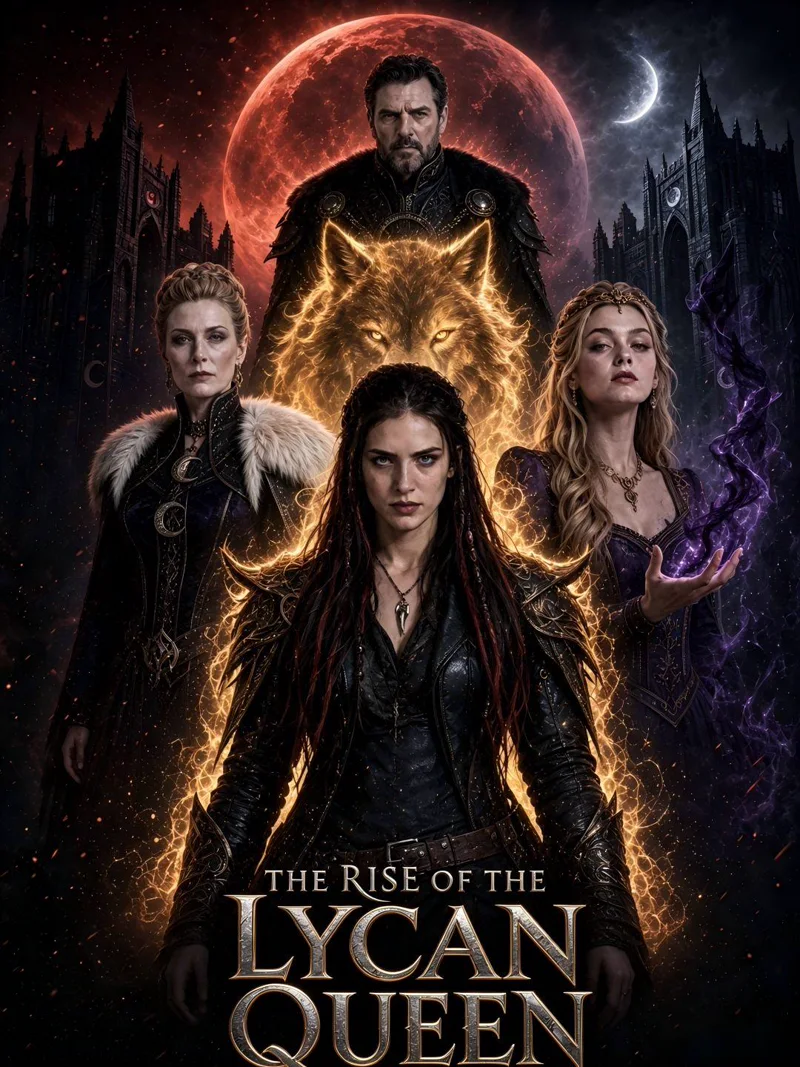
A stone gives a verdict in The Rise of the Lycan Queen. Ethan makes it a sentence. The difference is what gives the opening of this wolf-clan fantasy some force. Aleria is a princess of the Silver Moon Wolf Clan until the Moon God Stone identifies her as having no wolf and no blessing. Her father accepts the reading as sufficient reason to abandon her. Whatever status she had by birth turns out to be less secure than the authority of an object the clan has agreed to trust. The daughter is far too young to dispute the process. The people who ought to protect her must decide whether they owe her more than the ritual allows.
Two adults at the cliff
Lioriel's response is to put her child beyond Ethan's reach, at terrible risk. The cliff sequence gives the drama a decision with a violent ambiguity. A mother is trying to save her daughter through an act that would look like part of the danger from the outside. It is effective because the story has stated what accepting the clan's decision would mean before asking us to make sense of Lioriel's. She has no safe version of defiance available to her. For the purpose of a spoiler-light recommendation, it is enough to know that her daughter survives and that the apparent finality of the moment will have a complicated history.
Theo, leader of the Shadow Clan, takes Aleria in and raises her. This is a quieter reversal than the opening offers, with greater consequences than a last-minute catch would have by itself. Rescue lasts for a moment. Adoption gives her a home and an opinion of what belonging can look like over time. It also gives the audience an adult with authority who uses it very differently from Ethan. Both leaders occupy positions in worlds with rules and claims on their loyalty. They make decisions about the same child that show us how little those obligations determine by themselves.
Aleria's later decision to seek her origins interests me more than whether the original test will turn out to have overlooked an extraordinary power. She has reasons to make the search. Some of the events that shaped her are known to other people through decisions taken when she was unable to give an account of herself. She has reasons to leave them alone, too. She has a home, and opening the old case puts it in contact with a family that allowed a test to decide what to do with her. Finding an answer can be a gain even if it gives the old world an unwelcome way of addressing her.
The encounter with Lioriel matters because the biological family is not a single object to accept or reject. The mother who risked losing her has an account of what loyalty required. The father who abandoned her has another. Reading those two actions together turns the story into something more difficult than a royal restoration. Coming to care about one of the people she lost does not settle what she owes another. Nor does any of it erase Theo's claim to a place in her life. That is the aspect of the series I would recommend to audiences who have seen enough fated-heir stories to want a reason to keep watching after the first powerful reversal.
The years between the reversals
The opening is crowded with decisive acts. A ritual excludes a child, an adult ratifies the result, and a protective choice puts the infant's survival in doubt. This is useful velocity when the point is to make the danger of an old social system plain. The part after the rescue has different work. Aleria needs a place in the Shadow Clan solid enough to make an eventual journey into her history a choice she can take or decline. A lone sentence about being raised kindly can bridge years of story. The emotional force of the return depends on how much meaning the audience can give those intervening years.
What is familiar here is the unpromising child of a powerful lineage turning out to be worthy of attention after all. The two households make that shape more interesting. The clan of birth can tell Aleria something about her beginnings. The clan that raised her can tell her about the person who has reached the point of asking. Those answers do not have to contradict each other until somebody insists on choosing one as a source of rank. I would be less invested in the later story if some fresh test of exceptional power simply replaced the stone's early assessment. The original cruelty would still deserve scrutiny if the result had been accurate.
This is best approached as an adoption and origin story inside a big, clear fantasy conflict. Viewers who want a romance to dominate from the first scene may find the story's first obligations elsewhere. There is plenty of stature in a lycan queen's title. The opening asks a more useful question. What will a clan do for somebody before it has a title it can attach to her? Theo's answer gives Aleria a basis for judging what other people try to tell her when she is old enough to return.
Main Characters
 Aleria
 is at the center of the clan’s judgment ritual, where a child’s future is decided by a stone. She must confront customs that turn family identity into a public verdict.
 Ethan
Ethan is tied to the child whose place in the clan is being tested. His response to the ritual reveals what he is willing to risk when tradition threatens someone he loves.
 Lioriel
 is part of the Lycan court’s political circle, where ritual and status shape personal choices. Their position gives the clan’s verdict consequences beyond one family.
 Theo
Theo is connected to the family at the heart of the stone ritual. His role brings the cost of the clan’s decision into the story’s personal rather than ceremonial terms.
Frequently asked questions
Why does the clan reject Princess Aleria?+
The Moon God Stone declares that Aleria has neither a wolf nor a blessing. Her father Ethan accepts its verdict, while her mother Lioriel tries to get her to safety.



