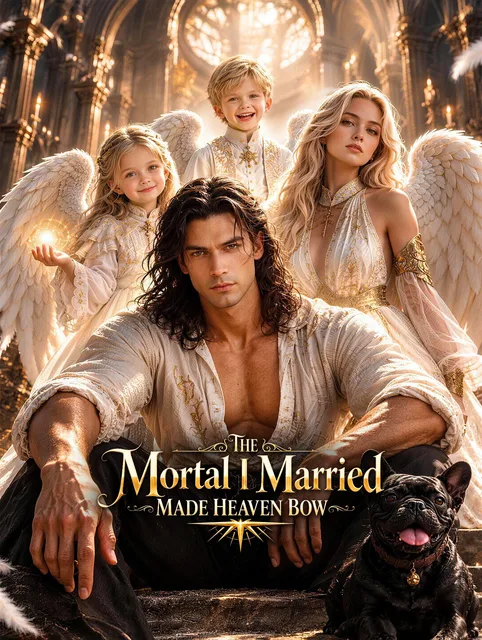
An angel goes looking for a blacksmith
Of all the people a six-winged angel might seek out when her family is in trouble, a man who works at a forge sounds like a distinctly earthly choice. Inaris has an excellent reason for making it. Six years earlier, the blacksmith saved her life. Now she has twins to protect and a marriage she wants to escape. When she goes back to find him, she is acting on the best evidence she has about his character. The audience happens to know something rather more spectacular about his identity.
The blacksmith is Diablo, a demon king living among humans. That information is the invitation to The Mortal I Married Made Heaven Bow, and giving it away at the outset is a sound decision. There is little mileage in a mystery whose title all but announces that somebody has been gravely underestimated. There is considerable mileage in watching a woman make a defensible decision without knowing quite how dangerous, or how resourceful, her chosen ally may be. The difference matters to a story about whom she can trust to help her keep a family together.
Six years between a rescue and a request
The first rescue establishes a debt without specifying how anybody ought to repay it. Diablo helps Inaris while living under another identity. Whatever a demon king might gain from a public alliance with an angel, a blacksmith cannot claim much public credit for one. That is a persuasive detail in his favour. It also puts a limit on what Inaris can know. A good deed gives her grounds to believe he will help. It gives her almost no information about the enemies, obligations or reach of the person offering that help.
Six years later, Inaris is the one who sets events in motion. The proposed marriage puts her future at the disposal of other people. The twins give every possible response a consequence beyond her own happiness. Staying could preserve the appearance of order at a cost she considers unacceptable. Leaving requires her to take children into an uncertain situation and depend on a man she remembers from another stage of her life. Flight takes nerve, but choosing a destination takes judgement. The second decision tells us more about her than the first.
That is also why the interval between the two encounters earns its place. Six years is long enough for gratitude to have cooled into a more durable opinion. It is long enough for an adult to acquire responsibilities that a rescuer could never have anticipated. The story can cut across the interval quickly because the twins make the passage of time concrete. We meet a woman for whom safety must now be calculated several ways at once. An old kindness suddenly has to withstand a much heavier demand.
The dignity of an ordinary occupation
Consider the choice of a blacksmith as Diablo's cover. A smith has a trade, a place in a community and a plausible reason to possess considerable strength. Somebody can seek him out. A nameless traveller who had once intervened on Inaris's behalf would offer the prospect of a quest. A man associated with a forge offers the possibility of a home. Even before the heavenly stakes come into view, that difference gives the reunion a quality of domestic hope often missing from tales about spectacular hidden powers.
It gives Diablo a dilemma of his own. The ordinary identity helps make him approachable to the woman who needs him. The authority he keeps concealed might be precisely what she needs when ordinary protection runs out. Revealing it would require her to revise her understanding of the person to whom she has entrusted the children. Continued concealment would leave her making serious decisions with incomplete information. A display of strength may settle a physical contest in a moment. It cannot settle whether somebody deserved to be told the truth earlier.
For me, that imbalance of knowledge is a better reason to watch than the invitation to see Heaven humbled. Cosmic hierarchies operate at a scale at which almost any reversal can be arranged by inventing a stronger being. The memory of a particular person arriving in a moment of danger is much harder to replace. It makes sense of why these two should meet again even if one takes away the titles, the wings and the promise of a confrontation between realms.
The audience for a domestic celestial fantasy
The evident risk is one of proportion. Every new measure of Diablo's power can make the initial question of Inaris's choice seem smaller. Viewers who want an intricate account of heavenly politics may likewise find that the family's needs dictate where their attention is supposed to go. The combination works best for people who like a hidden-identity story in which recognition has emotional consequences. It is satisfying to know a secret ahead of the heroine when there are good reasons for respecting the conclusions she reaches on her own.
I would give this one a look for Inaris in particular. She seeks out a man because of what he did when he appeared to have no standing at all. In a story populated by beings who could introduce themselves by rank, she has chosen a surprisingly reliable way of deciding whose door to knock on.
Genre & Themes
Primary genre: Fantasy romance Tags: Hidden identity, celestial hierarchy, family protection, reunion, arranged marriage
Main Characters
 Inaris
 brings her twins to the blacksmith who once saved her, seeking an ally. She does not know the man has hidden his identity as the demon king.
 Diablo
 is the blacksmith who once saved Inaris and now conceals his identity as demon king. Her return with the twins forces his private past into a larger conflict.



