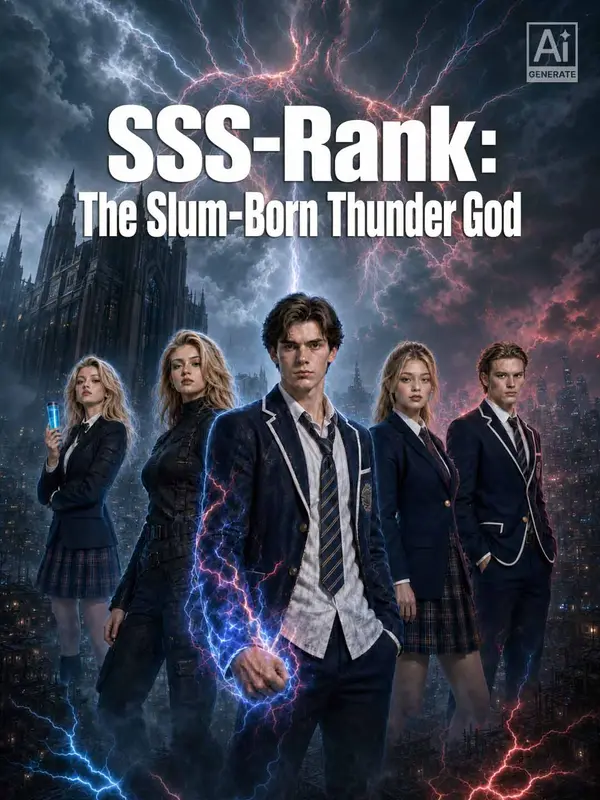
The Price of a Vial in SSS-Rank: The Slum-Born Thunder God
The most expensive object in Nate Ryder's world is small enough for a school bully to crush. It is a vial of Awakening serum, bought at a cost to his father's health. Tyler can destroy it in an instant. For Nate's family it represents something that cannot be replaced by obtaining another vial. His father has already paid with part of his bodily well-being. That is a more persuasive introduction to economic inequality than a tour of the rich students' homes would have been. The price of a thing depends very much on whose hands it is in.
Nate is believed to have failed at his Awakening. He knows that he possesses the exceptionally rare SSS-rank power of the Thunder God. Tyler, an A-rank student with influence among the school authorities, believes himself so far above Nate that there is little danger in humiliating him. Here is the fundamental pleasure of the series stated plainly. The person best placed to read the rankings accurately has the least public credibility, and the people with access to the entry list for the national tournament have a vested interest in keeping it that way.
The people who made it possible for Nate to arrive
His mother has been paralyzed for ten years. The story presents her as a reason he keeps going. That choice has more force alongside the father's decision about the serum. Nate has grown up among people for whom the difference between possessing physical strength and lacking it is measured in the ordinary demands of a day. At school, strength confers prestige and opportunities to be seen. In the Ryder home a loss of health already has a history and a cost that will still be there after an audience has finished applauding.
Tyler's bullying becomes politically interesting once administrators help him try to keep Nate out of competition. A tournament ought to offer precisely the circumstance in which a boy without influence can make a demonstration that others must acknowledge. Control over entry can undo that promise without ever altering a score. Tyler understands this remarkably well for someone so confident of winning. An A should beat a failure in an honest contest, on Tyler's own understanding of the rules. Yet he is prepared to interfere with a supposedly inferior opponent's opportunity to compete, which suggests that the school has already taught him a good deal about how its hierarchy is maintained.
Genre and themes
Primary genre: Superpowered tournament fantasy. Themes: class prejudice, concealed ability, family sacrifice, school corruption, public vindication.
From the school register to the arena
What I like about Nate's concealment is the tactical problem it creates for the storytelling. A revelation on the spot might put an end to an individual humiliation. It could also leave untouched the arrangements that made it possible for an official to dismiss him in the first place. Remaining quiet buys him time to train and keeps a public demonstration in reserve. It obliges him to tolerate a judgment he knows is false, sometimes in circumstances where his father's sacrifice makes that tolerance particularly hard to watch.
The Federal Awakened Selection Tournament changes the audience for the dispute. Tyler wants thousands of people to see him defeat a failure. That same crowd is valuable to Nate for almost the opposite reason. It offers him the possibility of being seen by people with no prior commitment to the version of events circulated at school. A contest between two differently ranked young men takes on the quality of an appeal against an institutional decision. The people who tried to suppress the evidence cannot as readily control what so many witnesses will take away.
Tyler has made an odd choice of audience for his own display of superiority. Every witness he hopes will talk about the contest tomorrow is also a witness Nate will never have to recruit.
Picture the difference between the available audiences. At school Tyler can break something in front of Nate and count on the adults to decide whether the incident merits attention. In an arena there are witnesses in every direction and no practicable way for an administrator to collect all their accounts before they leave. The tournament earns its place at the far end of the story because Nate needs more than a chance to compete. After all the quiet work that went into excluding him, he needs people who can go home and say what they saw.
There is a weakness in a justice system that requires the victim of a wrong to turn out to be the rarest talent on Earth. Nate's power makes an excellent attraction for an audience, but what of another child who really did fail at Awakening and whose father paid an equally terrible price? The question gives this otherwise exuberant comeback a slightly bitter edge. I would recommend it to viewers who like the build-up to a tournament at least as much as its result. Long before the Thunder God has an arena, the easily crushed vial has told us what sort of victory this family can reasonably hope for and what no display of power can ever give back.
Main Characters
 Nate Ryder
 hides a rare Thunder God awakening while pursuing a place in the national tournament. A damaged vial and a rigged entry process make his climb personal.
 Tyler
Tyler is involved in the tournament path that Nate must navigate. His connection to the damaged vial and compromised entry process adds pressure to Nate’s concealed power.
Frequently asked questions
Who is Tyler?+
He is an A-rank student who bullies Nate and works with school officials to keep him from competing.
What is special about Nate's Awakening?+
Despite his public reputation for failure, Nate has awakened the exceptionally rare SSS-rank Thunder God power.



