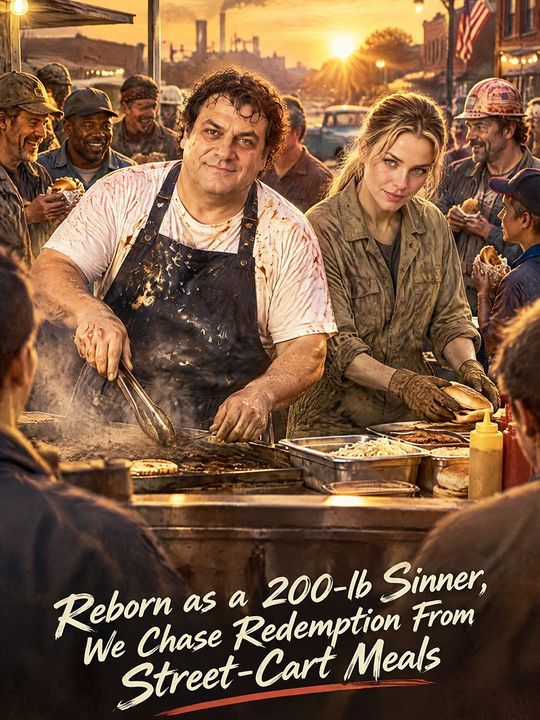
The fried chicken sandwich has two customers in this story. One is a hungry stranger with money to spend. The other is the woman at home who has every reason to doubt the man selling it. The stranger can be won over in a few bites. His wife needs evidence that a husband who has hurt her can become someone she might safely share a life with. A street cart is a modest place to begin either transaction, which is exactly why it makes such a good starting point for this unlikely marriage of a business serial and a domestic redemption story.
1996, with a balance already owing
An explosion ends a food magnate's life. He wakes in 1996 in the body of a man who weighs two hundred pounds, owes money and has abused his wife. The first of those facts supplies the provocative wording of the title. The last two explain the trouble he is actually in. His expertise has survived the journey, but his capital and reputation have not. At home he inherits the consequences of conduct he remembers from a different position than his wife does. She has lived through it. Whatever explanation he might give for his changed intentions, she has sound reasons to judge him by what happens next.
Divorce is already a possibility. That puts a time limit on the marriage plot without offering any similar guarantee about the business. A cart can take as long as it takes to acquire regular customers. A wife need not stay to watch the experiment. The gap lends a note of uncertainty to an otherwise confident entrepreneurial fantasy. Someone with a food mogul's experience can plausibly know a great deal about selling lunch. Nothing in his previous career qualifies him to ask an injured person to revise her assessment of danger. Even good news about the takings can reach the kitchen at home to an entirely different reception.
What's cooking at the cart
Fried chicken sandwiches are a smart choice of product. The customer understands what is being offered, the proprietor can sell one portion at a time, and the distance between labor and income is short enough to make the hero's progress legible. The show does not need to teach a seminar on how to run a restaurant group before a sale can mean something. Each sandwich represents a small use for knowledge carried across lifetimes. The former magnate has to put that knowledge back into his hands. People who find grand speeches about second chances tiresome may enjoy the prospect of one measured in hot meals.
From the cart, ambition stretches toward restaurants and conflict with ruthless competitors. This shift of scale offers the audience one of the reliable pleasures of a business drama. A skill that worked when its owner controlled every portion must hold up against opponents who have resources of their own. There is a danger here too. Victory over a rival can look so much like proof of personal merit that a story quietly starts to confuse commercial competence with goodness. This particular man could become the best cook on the street while owing his wife precisely as much as he did that morning.
Her injury while fighting a fire brings that distinction into focus. The money he has accumulated suddenly has a possible use quite different from expanding his business. The important question is what he is prepared to give up for her care. It would be easy to treat the fire as the moment at which he finally gets to be heroic. Look instead at who went toward the flames in the first place. His wife has a capacity for action quite independent of what happens to her marriage. Keeping that in mind gives the emergency a human center beyond the proprietor's next big decision.
Shelf placement
Primary genre: Second-chance drama
Themes: Rebirth, family ethics, entrepreneurship, marriage
Over fifty-two episodes the story changes its unit of measurement several times. A day at the cart can be counted in portions sold. A growing restaurant business invites comparison with competitors. A medical emergency turns attention to what money can obtain quickly enough to matter. Those changes of scale give a familiar rise-from-poverty plot an effective rhythm. The harder thing to count is the accumulation of evidence between husband and wife. A person who once feared a partner may value an ordinary day of dependable behavior more than the gesture that looks most impressive to an outsider.
I would recommend this most readily to someone who likes watching a character put practical knowledge to work under constraints. There is genuine ingenuity in sending an expert back to a period when, for him, a sandwich has to carry the weight of an entire career. The domestic plot asks a more uncomfortable question than the business plot, and viewers sensitive to easy absolution have good reason to keep asking it. A growing enterprise makes a lively reason to tune in tomorrow. The better reason to care about its owner is the possibility that he might learn when to stop counting what he has built and ask what his wife actually needs.
Main Characters
 The reborn food entrepreneur
A food magnate starts again in the body of an indebted husband. He puts his knowledge to work selling fried chicken sandwiches.
 His wife
She faces the prospect of divorce after abuse. Her intervention in a fire tests what her husband will sacrifice for her care.
Frequently asked questions
When does the entrepreneur start his second life?+
After an explosion, he wakes in 1996 in the body of an indebted husband facing divorce.
What does he sell first?+
Fried chicken sandwiches provide a modest starting point for a larger restaurant business.
Is this primarily a cooking tutorial?+
It is a 52-episode family and business drama. The street cart connects the hero’s professional skills to his effort to rebuild trust.



