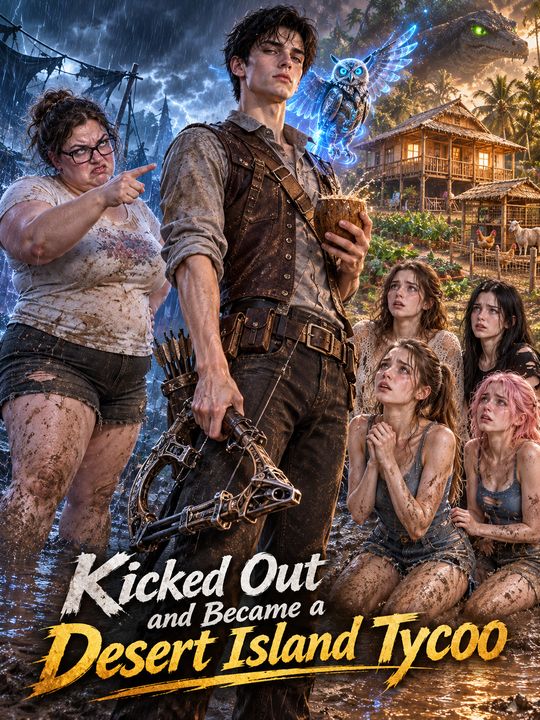
Arthur's fortune begins with a problem that can't usually be solved by getting rich: nobody on a deserted island has a shop to spend money in. He has been falsely accused and expelled from the camp where a group of other survivors has gathered. Shelter, useful tools, and something as ordinary as salt are worth more than an impressive bank balance. Then a holographic system gives him a way to produce those things. The title promises that being thrown out will make him a tycoon. The clever part is that the series has to invent an economy before it can make the promise good.
The system changes what counts as a resource
On the beach, the survivors have collective advantages Arthur lacks outside the camp. A group can divide work and make a shared shelter. It can also decide whose account of an incident it is prepared to believe. When the women expel him, their immediate authority is the ability to withhold the benefits of being part of the group. The island makes that a much more serious decision than excluding somebody from an argument. Where Arthur will sleep and what he can use to live through bad weather suddenly depend on a set of relationships he has been denied.
The system gives him access to materials and equipment whose value the situation makes easy to understand. Salt is a particularly good detail. An impressive weapon can do the work of intimidating another character, but an ingredient people rarely worry about buying makes a clearer point about what isolation does to daily life. The first signs of abundance are interesting because they change attainable tasks one at a time. A shelter buys time in bad weather. Tools let him think about shaping the place where he has landed beyond the needs of one night. As the advantages accumulate, Arthur gets to approach the island as someone who can improve a position instead of looking for permission to occupy one.
Genre and themes
Primary genre — Adventure
Themes — Fantasy, Revenge Drama, Business, Hidden Powers
What the typhoon does to the price of admission
The storm is the natural test of the two arrangements. Until then the other survivors can argue over the decisions that have left them struggling, and Arthur can turn his discovery into a fortress at his own pace. A typhoon gives everyone the same problem and very different ways to respond to it. The group that once had the power to throw Arthur out now needs him to let it in. That is a stronger reversal than having him return to camp simply to demonstrate what he has made. The people facing him have a need they cannot satisfy by pretending their first decision was harmless. His control of shelter becomes authority over the terms of the next encounter.
The choice to make them sign punishing labor terms is where the show gets sharper and less comfortable. It gives Arthur an opportunity to treat a life-saving resource as a bargaining instrument just as the camp had earlier used access against him. It also makes it possible to see a big difference between the way the two sides exercised their power. A person can understand why a survivor who has been treated unfairly would demand something in return and still question how much any agreement made under the pressure of a deadly storm can mean. I found myself rooting for Arthur to make it through the storm and wondering whether I'd want to live under the rules he'd make afterward.
From useful objects to an island economy
Arthur starts as a man who needs to find a way through his next night. Building a working stronghold gives him reasons to think on a longer scale. The eventual agricultural enterprise takes that idea even further. Skills and supplies have transformed the possibilities of the terrain, and they have also given one person the leverage to set expectations about labor. That's an intriguing outcome for a premise that begins by showing what happens when a group exercises power without listening. The other survivors react to him initially from a position of control and later from one of need. The biggest change in Arthur is that he finds out how much he enjoys having a choice about the rules, well beyond the first satisfaction of getting through the storm.
The opening is built for short episodes. Banishment creates an immediate practical problem, and the system answers it with a device that can produce one visible result after another. The weather then compresses the time available for both sides to act. The later leap to a farm empire is entertainingly bold, but it can make the costs of building a community seem too easily solved by a better-equipped leader. The more patient part of the story is the negotiation over a safe place to stay. The tools can make Arthur capable of offering shelter. They cannot decide which obligations ought to come with it.
Salt is a welcome detail in a story that eventually puts a fortress on the beach. Before the typhoon, a useful thing is something Arthur can make. At the gate, it’s something he can withhold. The series has an ugly sense of humor about that shift, which is what I’d recommend it for.
Main Characters
 Arthur
An island survivor expelled from the beach camp. A survival system gives him the supplies to build his own stronghold.
 The Beach Camp Survivors
The group that expels Arthur and later finds that its safety depends on the shelter he has built.
Frequently asked questions
How does Arthur survive being cast out?+
He gains access to a system that can produce supplies including tools, shelter materials, and salt.
What brings the other survivors to Arthur’s fortress?+
A typhoon makes them seek protection inside the fortress and gives him the power to set terms.
How many episodes are there?+
The ranked edition contains 41 episodes.



