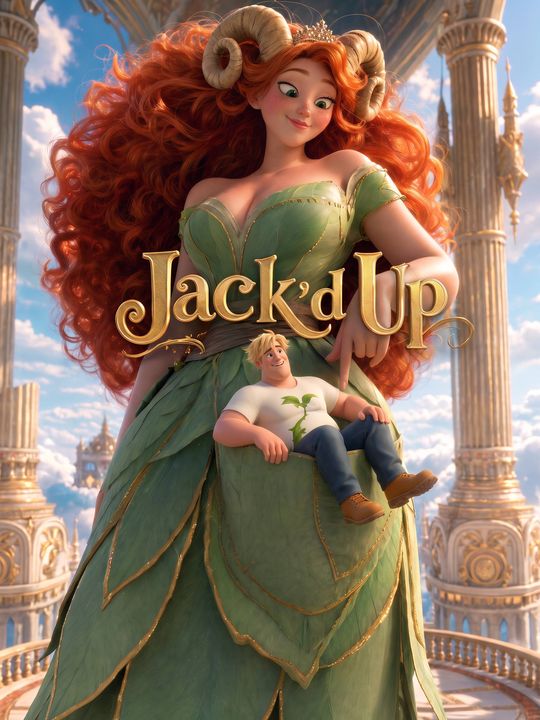
The beanstalk in Jack’d Up gets its human climber into the sky. Getting him through an encounter with a giant princess is another matter. The old fairy tale gives its small trespasser a house to raid and a giant to evade; this animated short drama builds its comedy around meeting somebody in that enormous world who has a reason to engage with him. Their difference in size practically writes the first joke. Keeping the two of them interesting after the joke lands is the more ambitious part of the premise.
Jack begins on the human side of a boundary most people have no way to cross. A magic bean produces a climbable route to a kingdom in the clouds, and he takes it. The important thing about the climb is how little preparation it buys him. He knows how to get up there, but reaching the top supplies no knowledge of how to live among giants or how to make sense of a princess from their world. The story's invitation is unusually clean. Every familiar instinct that carried him toward the unknown can become a liability once he meets somebody who belongs there.
Three things the beanstalk changes
First there's the bean itself, an object small enough to fit in a hand with a consequence big enough to redraw the landscape. The disproportion is the opening expression of an idea the series keeps returning to. Jack's vulnerability in the upper kingdom follows from a choice he actively makes, so the fantasy carries a stronger charge than an accidental trip through a portal. Of course he wants to find out what is up there. The premise asks how much he is entitled to do with what he finds.
Then there's the transition from the climb to the kingdom. The vertical journey creates a before and an after that a short episode can communicate almost instantly. The climb has an obvious goal and a visible direction. The place above it presents a much less obvious question: what does the visitor owe the people who already live there? Moving from a physical goal to a social one gives the serial somewhere to go when it has spent its big arrival.
Finally, the princess makes the scale difference personal. An empty giant landscape would offer spectacle, and a hostile giant would offer a chase. A giant woman Jack can talk to introduces an entire category of uncertainty. A gesture that feels ordinary to her can seem consequential to him. Curiosity can look like scrutiny from the other side. The encounter has comic potential because the two people can interpret the same moment very differently, with room for their relationship to change as those readings become less reliable.
A visitor and a local
Jack's decision to climb tells us something that the fairy-tale name alone cannot. He is willing to put himself in a situation where the terms are unclear. That makes him an easy character to follow into an adventure and a potentially difficult person to trust within one. A series that lets Jack's boldness cause trouble can get more out of him than one that treats every risk as evidence of an uncomplicated heroic streak.
The princess brings a different kind of power. She has size and status, and the sky kingdom is familiar territory to her. The encounter gives her another decision, though. She can read Jack as an intruder, a curiosity, or somebody whose presence gives her a reason to question what she takes for granted. The attraction of the pairing is that it leaves both characters with something to learn, even though one of them has far more control over the immediate situation. Jack needs to be taken seriously in a place where it is easy to overlook him. The princess needs enough agency of her own for her interest in him to carry weight.
After the climb
Magic beans, giants, and a reckless visitor are old ingredients. Giving the princess the central encounter turns that borrowed machinery toward romance and comedy. It also exposes the most obvious limitation of the setup. Bigger furniture can only surprise a viewer so many times. The more durable jokes are the ones that affect how the pair understand each other, and the more durable suspense comes from whether they will use that understanding well. Giving a conversation space to breathe after the climb can therefore matter as much as delivering another visual surprise.
The story suits a short-drama pace precisely because the ascent, arrival, and meeting each change the kind of question the viewer is asking. Who wouldn't want to see the top? What does Jack do now that he's reached it? Why does this particular person matter to him, and what does she make of him? The transitions are simple enough to carry the viewer through small installments. The test is whether the romance builds its own momentum once the geography has done its work.
Where it fits
Primary genre — Fantasy
Themes — Adventure, Animation, Romantic Comedy, Romance
I’d stay with Jack through the climb just to see what happens when the person he meets has a completely different idea of what counts as an ordinary day. The princess has the better position and the better view. He’s the one who has to find a way to make himself heard.
Main Characters
 Jack
A human adventurer bold enough to climb a beanstalk into a kingdom that makes him look very small.
 The Giant Princess
A princess of the kingdom in the clouds whose encounter with an unexpected visitor gives the adventure its romantic and comic tension.
Frequently asked questions
Does Jack’d Up retell Jack and the Beanstalk?+
It borrows the magic bean and the climb into a world of giants. The meeting with a giant princess redirects the setup toward romantic comedy.
How many episodes are in Jack’d Up?+
The cataloged edition contains 61 episodes.
Is Jack’d Up animated?+
Yes. It is an animated short drama with a fairy-tale setting and a size-mismatch romance.



