The worst possible draft pick
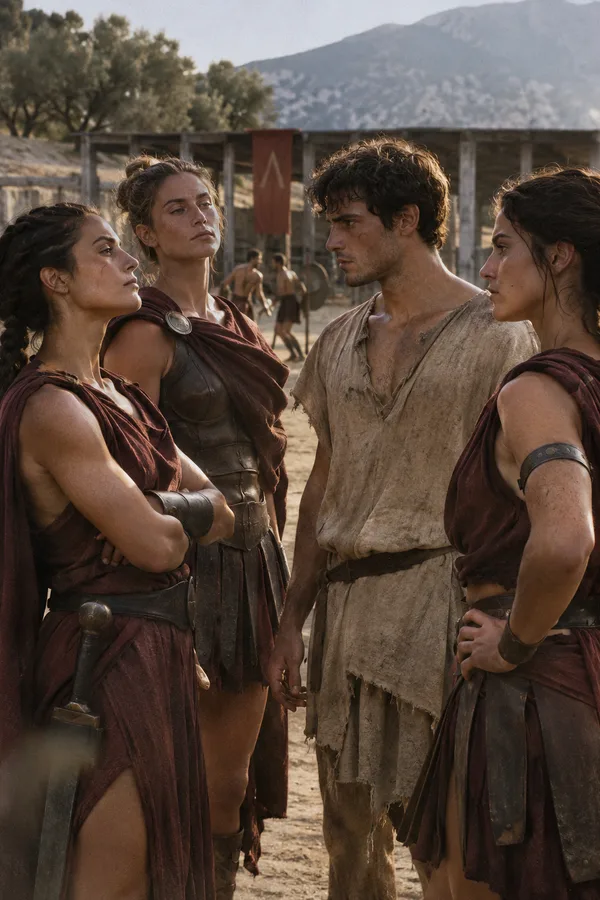
Sparta makes the first move in I Got Three Girlfriends From the System. Jason arrives from another life, lands at the bottom of the social order and has to choose three women whom everybody else has written off. It is an odd kind of privilege to confer on a man with so little standing. He can apparently decide something quite momentous for three other people while having almost no say in what happens to him. That crooked distribution of power gives this otherwise cheerfully outrageous action fantasy something to chew on.
This is an imaginary Sparta with very little interest in the historical record. Its reputation as a place that prizes military excellence does most of the work. An audience knows at once which people this society expects to win a fight and which it considers disposable. A newcomer who understood its rules perfectly might spend his life climbing one rung. Jason has a much better reason to disregard the whole ladder. The rules he brings into play belong to a different century and, for that matter, to a different genre.
An affection score with an alarming payout
Once Jason is linked to the three women, a system translates their increasing affection into access to modern weaponry. A romantic development can now change the balance of military power. The title makes it sound as though a machine hands a lucky fellow three girlfriends. The more interesting detail is that the machine needs something from them. Jason can accept a match under compulsion. He cannot simply declare that somebody else feels more warmly towards him and collect the reward.
There is an uncomfortable joke here about the way games teach players to approach other people. A player presented with a relationship meter soon starts wondering which action will move it. Jason has a much stronger incentive than most players. Other people's safety may depend on what he unlocks. A kind gesture could be perfectly sincere and still serve his interests. Equally, keeping his distance in the name of honesty would leave all four of them exposed. It is an unusually effective complication for a fantasy ostensibly devoted to making its hero's life easier.
The women enter as fellow outsiders, though the circumstances under which they join him are hardly equal. The community has already passed judgement on their desirability. Now another authority proposes to measure what they feel. The premise is at its sharpest when you notice who gets to read the result and who has to live it. A number might tell Jason that something has changed between them. It could never tell him what any one of the three gave up in deciding to trust him.
Three hundred very confident opponents
The arrival of three hundred elite Spartan fighters is the right sort of escalation for such a ridiculous idea. A single opponent could lose through bad luck. An entire force represents the society that first classified Jason and his companions as negligible. Facing that force with weapons from the modern world gives the confrontation the force of a punchline. All the expertise by which the Spartans have learned to judge an enemy has suddenly become a poor guide to their chances.
That disproportion is also where the suspense has its limits. Once the technological gap is apparent, the prospect of a reasonably even military contest grows remote. The pleasure shifts to anticipation. How long will people who have made a profession of recognising strength take to recognise the kind standing opposite them? For a short drama, that change of emphasis is economical. It permits an escalation in scale without asking the audience to remember a campaign map or follow a succession of military alliances.
I prefer the opening choice to the prospect of overwhelming firepower. In the former, nobody yet understands what the four outsiders might be worth to one another. There is room for surprise in several directions. In the latter, the advantage can be understood almost at a glance. A longer stretch devoted to the women's separate reactions would buy the story something that another military upgrade cannot. Three different people could have entirely different reasons for trusting the same man, and those differences matter once trust acquires a price.
Who gets the best bargain?
There are two familiar fantasies at work here. One lets an ordinary outsider enter an established world with knowledge its inhabitants lack. The other surrounds a male lead with potential partners. Making one fantasy pay for the other is the genuinely inventive touch. The result suits viewers who enjoy following a peculiar rule to its most extravagant conclusion. It is much less suited to anyone hoping for a delicate account of courtship or a plausible picture of life in an ancient city.
My recommendation comes down to the compulsory selection. Remember it when the military spectacle arrives. The people in charge put these four together because they could see no particular value in any of them. That single piece of administrative contempt makes their eventual ability to stand together far more satisfying than the prospect of Jason arriving fully armed. The machinery is fanciful. The experience of being badly underestimated is wonderfully easy to recognise.
Genre & Themes
Primary genre: Progression fantasy Tags: Transmigration, alternate Sparta, multiple-partner romance, underdog action
Main Characters
 Jason
Jason receives a second life in Sparta and must choose three women in a city that measures men by strength. His predicament tests whether influence can mean anything other than military power.



