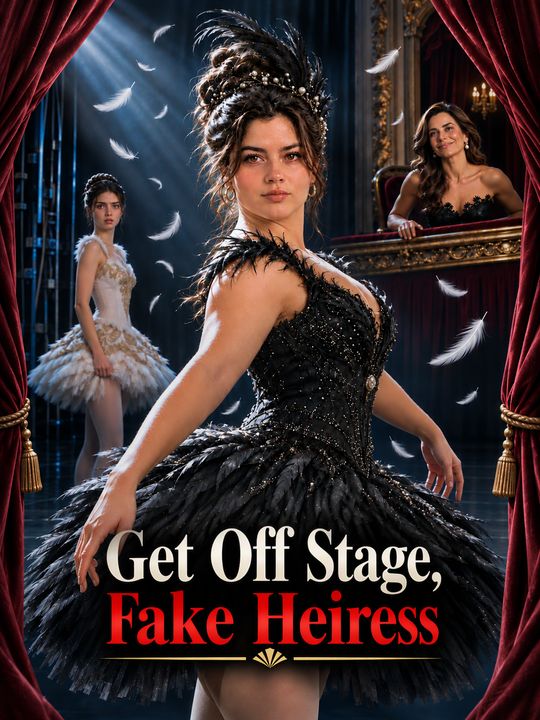
Backstage is a peculiar place to hide a dancer. You can keep her out of the audience's sight, deny her a billing and give her work that leaves other people free to rehearse. What you cannot do quite so easily is keep her away from dance. That contradiction gives Maya Hawthorne's story its flavor. A switch at birth has put the heir to a ballet dynasty to work behind the scenes of her own family's enterprise. Twenty years later, she is close enough to its art to practice in the shadows and sufficiently far from its privileges to know exactly what admission costs.
A company with two lines of succession
Chloe has the Hawthorne name, its material comforts and the assumption of talent that attaches to a famous artistic family. Maya has a gift for dancing and none of the social protection talent is supposed to bring. Chloe can humiliate the backstage worker without having to demonstrate that she could outperform her. For an audience that knows about the exchange at birth, this makes for a particularly satisfying kind of dramatic irony. Every time someone takes Chloe's standing as proof of her superiority, we get a glimpse of how little judgment might actually be required to run a supposedly exacting institution.
Ballet makes the switched-heiress formula unusually revealing. Money or property can change hands when a document turns up. A family name can be restored in a single announcement. A dancer has to do something in front of people who came to watch. In Maya's case those people have already been encouraged to regard her weight as disqualifying. The revelation of her birth can open one argument while leaving the other wide open. Even if everyone agrees on whose child she is, they may still disagree about whose body they want to see in the center of the stage.
That second argument gives a hundred short episodes more to work with than a prolonged wait for a family secret to come out. Maya dances while she is still excluded. That matters more than any declaration that she has inherited her mother's ability. A gift might account for part of what she can do. Continuing to work on it in an environment arranged for someone else's benefit tells us something about what she wants. She has a relationship with dance that predates the prospect of being publicly rewarded for it. Take away the Hawthorne fortune and that relationship would still be there.
Who is judging the audition?
The taunts about Maya's body are a particularly mean form of advance criticism. They pronounce on the performance before she has had the chance to give one. The drama's answer is to treat strength as a virtue in the very body that observers have dismissed. This is a more interesting approach than promising the audience a physical transformation to signal that the heroine is finally ready for applause. It also makes an exacting demand on the story. An audience invited to believe in Maya as a dancer deserves occasions to think about her movement, not merely about the shocked faces of the people watching.
The Hawthorne inheritance complicates that pleasure in a productive way. Maya's talent is linked to her biological mother, whose stature helps explain why the revelation of the switch carries such force. Yet there is an awkward implication in any story that answers snobbery by announcing a heroine's superior pedigree. Would the backstage worker deserve a fair chance if her mother had never danced a step? That question does not spoil the fantasy for me. It adds a little resistance to an otherwise uncomplicated invitation to cheer. Maya's solitary commitment offers a better answer than anything a family tree could establish.
On the playbill
Primary genre: Family drama
Themes: Mistaken identity, high society, ballet, body prejudice
As the secret emerges, cruel mockery escalates into plots that threaten Maya's life. The move raises the stakes very quickly. It also risks stealing attention from the most distinctive struggle the writers have devised. A threat to someone's life can supply a cliffhanger in almost any setting. Being required to demonstrate grace before an institution that won't grant you the ordinary courtesy of an open mind belongs specifically to Maya. The backstage passages carry an extra charge for that reason. Each return to the work recalls what she stands to lose beyond money, safety or a place at the family table.
People who follow ballet for the patient business of instruction and rehearsal should expect a dynasty melodrama, complete with a usurper and dangerous schemes. For viewers who enjoy a richly deserved change in the pecking order, however, the choice of profession makes a substantial difference. Maya wants something no lawyer can simply sign over to her. She wants the chance to perform, and the only convincing way to collect that inheritance is to step out and dance. That is the payoff I would be watching for, well before anyone has decided which Hawthorne gets to keep the dressing room.
Main Characters
 Maya Hawthorne
Raised as a backstage worker after a switch at birth, Maya develops the strength and ability to challenge the ballet dynasty that excludes her.
 Chloe
Raised as the Hawthorne heiress, Chloe enjoys the company’s privileges and humiliates Maya over her body and position.
 Maya’s biological mother
Her reputation as a dancer shapes the family legacy Maya is expected to reclaim.
Frequently asked questions
What is the Hawthorne family business?+
The Hawthornes control a ballet enterprise, tying their family standing to access to the stage.
Does Maya begin dancing after the family secret comes out?+
She already dances in private while working backstage. The revelation changes her standing, not the origin of her ambition.
How many episodes feature the Hawthorne story?+
The Glow Romance edition spans 100 short episodes.



