Before there is a village to build
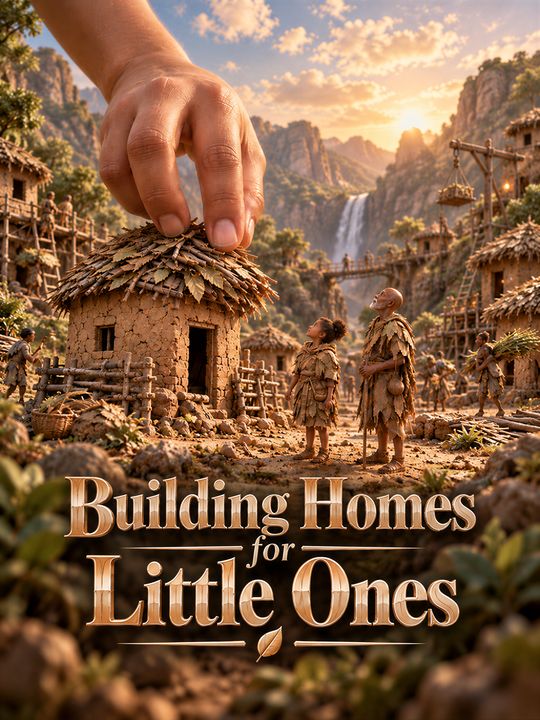
A roof can wait. Nora has arrived in a world of tiny people who need food and warmth before they need anything she could call a house. The first thing she wants from their world is a way out of it. She is pregnant, has no idea how long she will be stranded, and would prefer to be home when her baby comes. To the people at her feet, a woman of her size looks like a goddess. To Nora, the differences in scale only make the situation harder to explain. She is the largest thing in view and has remarkably little control over what happens next.
Teaching the villagers to make fire is a good first turn for the story. A fire has an immediate use, but the important part is that people can learn to make another one. The same goes for hunting. Nora can help because she brings knowledge from somewhere else, and the community has a future to plan for once she is gone. It changes the terms of their relationship. The villagers begin as people who need to be rescued from whatever danger is in front of them. Over time, they have ways to address some of those dangers themselves. That transition is more interesting than watching the giant in the room solve everything with her hands.
The story allows time for Nora to become invested in the village. On arrival she could have walked past its troubles if she had been able to find the exit. Once she teaches someone to do something as useful as making a fire, it is harder to think of them as scenery. By the time building shelter is possible, the project tells us something about how long she has been paying attention to other people’s needs. A completed home has an emotional meaning in a story about someone who still cannot find her own.
The trouble with being worshipped
Nora’s size gives her opportunities and creates obligations she never agreed to take on. The villagers depend on her and give that dependence a language of reverence. She still has the same deadline she had before she knew them. That makes the eventual discovery of a route home a real turn. She can finally consider doing what she came here wanting to do. She also has enough history with the village to know what her absence is likely to cost.
There is further trouble behind the villagers’ worship. The synopsis leaves the secret under wraps, which is the right amount to know before watching. Its place in the story is already suggestive. Nora has been doing things for the village in plain sight, while people around her know something they have not shared. Gratitude can be genuine and incomplete. The sudden danger around the route home gives her a reason to ask whether the community she now feels responsible for has been willing to treat her as a person with plans of her own.
Nora’s pregnancy makes the dilemma unusually persistent. The village can always use another day of her time, but that time has a different value to her. A more conventional fantasy visitor might settle into a new life and decide at leisure whether to leave. Nora cannot treat the decision as an abstract test of whether she is a kind person. She is thinking about getting through a birth in a place she never chose and about the people who have come to rely on her. That tension makes her initial reluctance credible and her later attachment more moving.
Genre and themes
Primary genre — Portal fantasy
Themes — Survival, pregnancy, community building, reluctant guardianship, secrets
Portal fantasies often make a traveler exceptional as soon as they arrive. Here the most appealing revision is how practical that exception proves to be. Fire, food, and shelter make a better measure of progress than the villagers simply calling Nora divine more often. They also give the pacing an intelligible order. The early shock of a change in scale makes way for the slower work of getting along. Once Nora has made a place for herself, the discovery of a way to leave and the emergence of a new danger can bring the pace back up without abandoning the relationships established in between.
I was more curious about what people would do with the things Nora taught them than about the next large object she might pick up. If the serial stops showing what they want and treats them solely as an obstacle between Nora and home, the secret and the late threat could flatten the community the early scenes work to build. The material is strongest when the villagers are doing things from which Nora can learn, or when their dependence on her makes an honest claim on her time. It is the difference between a village worth saving and a fantasy set with impressive little buildings.
By the time Nora has a roof worth finishing, I can see why she would hesitate at a chance to leave. A fire takes a moment to light. Building somewhere people can stay while you are gone takes considerably longer, and those are the parts of the fantasy I would come back for. Go in expecting some patient village life between the bigger revelations. The work of making a home deserves as much attention as the chance to walk away from it.
Main Characters
- Nora
An expectant mother who teaches the village survival skills while trying to find a way home.
 The villagers
A tiny community that comes to rely on Nora for food and shelter.
Frequently asked questions
Who is the main character?+
Nora is a pregnant woman who wakes in a world inhabited by tiny people.
Why do they see her as a goddess?+
She towers over them and helps them secure food, fire, and shelter.
What drives the story?+
Nora wants to get home before giving birth, even as the village grows to rely on her.



